Welcome, Beloved Chaverim!
Grace be to you, and shalom, from HaShem
Avinu, and from Yeshua Ben Yosef (our Suffering Servant). We are so grateful you have guided your steps to this space.
As we look at the world around us, it is clear that time is running out, and the
prophetic clock is ticking faster than ever. Now, more than any other season, it is vital for us to anchor our hearts in the true foundations of our faith. Whether you are a lifelong believer, new to the Messianic walk, or a seeker searching for the truth of the Scriptures, you are not here by accident. You are family.
Below, you will find a complete, ready-to-share guide mapping out the foundations
of our covenant life. We have framed this entirely through a Messianic Jewish lens, utilizing the beautiful terminology and faithful presentation of the Complete Jewish Bible (CJB).
May this resource bless you, challenge you, and strengthen your walk as we look forward
together to the imminent return of our King!
This guide presents the foundational truths
of Salvation and covenant life through a Messianic Jewish lens. Using the terminology, spelling, and theology of the Complete Jewish Bible (CJB), it maps out HaShem’s design for humanity, our internal struggle, the provision of Messiah Yeshua, and how a believer lives a Torah-based lifestyle
under the Brit Hadashah (New Covenant).
With time running out, understanding His first
appearance and His imminent return is more critical than ever.
Foundation 1. The Purpose of HaShem: Covenant, Shalom, and the Divine Potter
 The Main Takeaway: HaShem’s original intent for His creation, and specifically for His chosen people, is complete shalom
(peace, wholeness) and intimate relationship under His covenant. He designed us like a pristine, small clay jar in the hands of a Master Potter to reflect His glory.
- From the Tanakh (Hebrew Scriptures):
“But now, HaShem, you are our Father; we are the clay, and you our potter; we all are the work of your hand.” (Yeshayahu / Isaiah 64:7 [64:8] CJB)“For
I know what plans I have in mind for you,’ says HaShem, ‘plans for well-being, not for bad luck, so that you can have hope and a future.” (Yirmeyahu / Jeremiah 29:11 CJB)
- From the Brit Hadashah (New Covenant):
“For God so loved the world that he gave his only and unique Son, so that everyone who trusts in him may not have eternal destruction, but have eternal life.” (Yochanan / John 3:16 CJB)
Foundation 2. The Internal Struggle: Human Weakness and the Yetzer HaRa
 The Main Takeaway: Because of inherent human weakness, mankind repeatedly submits to the Yetzer HaRa (inherit sinful nature from Adam n Eve, the evil, selfish inclination) rather than the Yetzer HaTov (the good inclination). This choice shatters our lives like a broken clay jar, leaving us spiritually alienated and unable to perfectly meet His holy standards on our own.
- From the Tanakh (Hebrew Scriptures):
“But your iniquities have made a separation between you and your God, and your sins have hidden his face from you, so that he will not hear.” (Yeshayahu / Isaiah 59:2 CJB)“The heart is deceitful above all things and desperately sick; who can understand it?” (Yirmeyahu / Jeremiah
17:9 CJB)
- From the Brit Hadashah (New Covenant):
“Since all have sinned and come short of earning God’s praise.” (Romans 3:23 CJB)“For I know that nothing good lives in me, that is, in my old nature. For the desire to do good is inside me, but the power to do it isn’t! For I don’t do the good I want to do; instead, the evil I don’t want to do is what I keep on doing!” (Romans 7:18-19 CJB)
Foundation 3. The Divine Remedy: Yeshua Ben Yosef, Our Kapparah
 The Main Takeaway: HaShem provided the ultimate Kapparah (covering/atonement) for human weakness through His Messiah. In His first coming, He appeared as Yeshua Ben Yosef (the suffering servant) to bear our sins, conquer the power of the Yetzer
HaRa, and spark the dynamic process of our restoration.
- From the Tanakh (Hebrew Scriptures):
“But He was wounded for our transgressions, He was bruised for our iniquities; the chastisement of our peace was upon Him, and with His stripes we are healed. All we like sheep have gone
astray; we have turned every one to his own way; and HaShem has laid on him the iniquity of us all.” (Yeshayahu / Isaiah 53:5-6 CJB)
- From the Brit Hadashah (New Covenant):
“Yeshua said to him, ‘I AM the Way — and the Truth and the
Life! No one comes to the Father except through me.’” (Yochanan / John 14:6 CJB)“But God demonstrates His own love for us in that the Messiah died for us while we were still sinners.” (Romans 5:8 CJB)
Foundation 4. Teshuvah and Trust: The Return of Yeshua Ben David
 The Main Takeaway: With prophetic time running out, we must urgently experience Teshuvah (repentance) and place our Bitachon (active trust) in Him. The
ultimate restoration is at hand; the same Yeshua who came as the suffering Ben Yosef is returning soon as Yeshua Ben David—the reigning King of Kings—to establish His absolute authority.
- From the Tanakh (Hebrew Scriptures):
“‘See, the days are coming,’ says HaShem, ‘when I will make a Brit Hadashah with the house of Yisra’el and with the house of Yehudah... I will put My Torah within them and write it on their hearts; I will be their God, and they
will be My people.’” (Yirmeyahu / Jeremiah 31:30, 32 [31:31,
33] CJB)
- From the Brit Hadashah (New Covenant):
“But to as many as did receive Him, to those who trust in His Name, He gave the right to become children of God.” (Yochanan / John 1:12 CJB)“Look! He is coming with the clouds!
Every eye will see Him, including those who pierced Him; and all the tribes of the Land will mourn Him. Yes, Amein!” (Hisgalus / Revelation 1:7 CJB)
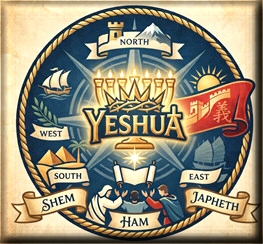
Traditional Messianic Responsive Prayer for Both Yisrael and All Nations
Post-Salvation: The Torah-Based Life of a Believer. Righteous Gentile believers are not required to practice ritual Torah only observe Acts 15:20-22 but can learn Moral teaching of the Torah

The Main Takeaway: In Messianic Judaism, salvation is entirely a free gift of grace through faith (bitachon), not something earned by legalistic performance. However, post-salvation, the Torah scroll serves as the holy, inspired blueprint for a lifestyle empowered by the Ruach HaKodesh (Holy Spirit).
Through Messiah Yeshua, our Yetzer HaTov (good inclination) is supernaturally quickened soul restored by Ruach HaKodesh. We do not observe the mitzvot (commandments) to get saved, but out of love because we are saved. Yeshua did not come to abolish the Torah, but to demonstrate its full, lived-out meaning:
“Don’t think that I have come to abolish the Torah or the Prophets. I have come not to abolish but to complete.” (Mattityahu / Matthew 5:17 CJB)
How the Mitzvot Apply to Everyday Lifestyle Practices:
- In Our Speech (Shmirat HaLashon / Guarding the Tongue): We actively abstain from Lashon HaRa (gossip and malicious slander) to honor the divine image in others.
- Torah: “Do not go around slandering your people, but do not stand by idle when your neighbor’s life is at stake; I am HaShem.” (Vayikra / Leviticus 19:16)
- Brit Hadashah: “Let no harmful language come out of your mouths, only good words that are helpful in meeting the need...” (Ephesians 4:29)
- In Our Business Practices (Marketplace Integrity): We practice complete honesty in our financial dealings, jobs, and transactions, viewing our work as an extension of our worship.
- Torah: “You
are to have a correct and honest weight, and a correct and honest dry measure...” (Devarim / Deuteronomy 25:15)
- Brit Hadashah: “Therefore, stripping off falsehood, let everyone speak truth with his neighbor...” (Ephesians
4:25)
- In Our Relationships (Love and Community): We reject bitterness, refuse to harbor grudges, and actively pursue reconciliation.
- Torah: “Do
not take vengeance on or bear a grudge against any of your people; rather, love your neighbor as yourself; I am HaShem.”
(Vayikra / Leviticus 19:18)
- Brit Hadashah: “Be kind and tender-hearted to one another, forgiving each other, just as through the Messiah God also forgave you.” (Ephesians 4:32)
- In Our Homes (L’dor V’dor / From Generation to Generation): We build homes centered on
the Shema, ensuring our children are taught the ways
of HaShem through everyday life rhythms.
- Torah: “And
you are to teach them carefully to your children. You are to talk about them when you sit at home and when you are traveling on the road...” (Devarim / Deuteronomy 6:7)
- Brit Hadashah: “Fakers, don't irritate your children and make them resentful; instead, raise them with the training and instruction that comes from the Lord.” (Ephesians 6:4)
-
 In Our Calendar (Set Apart Time and True Shabbat): We stop our routine worldly labor on the seventh-day Sabbath (Shabbat) and celebrate the biblical feasts (Moadim) to enter True Shabbat rest and reconnect with our Creator.
- Torah: “Remember
the day, Shabbat, to set it apart for God. For six days you have to labour... but the seventh day is a Shabbat for HaShem
your God…” (Shemot / Exodus 20:8-10)
- Brit Hadashah:“So there remains a Shabbat-keeping
for the people of God. For the one who has entered God’s rest has also rested from His own works...” (Messianic
Jews / Hebrews 4:9-10)
Hebrew Glossary and Transliteration Guide
- Avinu (ah-VEE-noo): Our Father.
- Chaverim (khah-veh-REEM): Friends, companions, or associates; used affectionately for community
members.
- HaShem (hah-SHEM): Lit. "The Name." The traditional, respectful term used to
avoid casually pronouncing the holy personal name of God.
- Yeshua Ben Yosef (yeh-SHOO-ah ben yoh-SEF): "Yeshua, son of Joseph." The prophetic
model of the suffering servant Messiah (Messiah son of Joseph).
- Yeshua Ben David (yeh-SHOO-ah ben dah-VEED): "Yeshua, son of David." The prophetic
model of the triumphant, reigning kingly Messiah (Messiah son of David).
- Yetzer HaRa (YET-zer hah-RAH): The internal evil, selfish, or rebellious inclination present
within human nature.
- Yetzer HaTov (YET-zer hah-TOHV): The internal good, selfless, or godly inclination that
seeks to align with God's will.
- Torah (toh-RAH): Instruction, teaching, or law; specifically the first five books of the
Bible, and broadly God's divine guidelines.
- Brit Hadashah (breet hah-dah-SHAH): The New Covenant / New Testament.
- Kapparah (kah-pah-RAH): Atonement, covering, or cleansing for sin.
- Teshuvah (teh-shoo-VAH): Repentance; literally "turning back" or returning to
God's paths.
- Bitachon (bee-tah-KHOHN): Active trust, reliance, and living confidence in God.
- Tanakh (tah-NAKH): The Hebrew Bible (An acronym for Torah/Teachings, Nevi'im/Prophets,
Ketuvim/Writings).
- Mitzvot (meets-VOHT): Commandments or divine deeds (plural of mitzvah).
- Ruach HaKodesh (ROO-akh hah-KOH-desh): The Holy Spirit.
- Lashon HaRa (lah-SHOHN hah-RAH): Lit. "Evil tongue"; gossip, slander, or defamatory
speech.
- L’dor V’dor (luh-DOHR vuh-DOHR): From generation to generation.
- Shabbat (shah-BAHT): The Sabbath day (observed from Friday evening to Saturday evening).
- Moadim (moh-ah-DEEM): Appointed times, holy days, or biblical festivals
